
Yellow-Crowned Night-Heron: Florida's Crab-Eating Night Hunter |
Look for the blocky head, black-and-white face and yellow crown — then check the tide, because coastal feeding often follows high-water timing. |
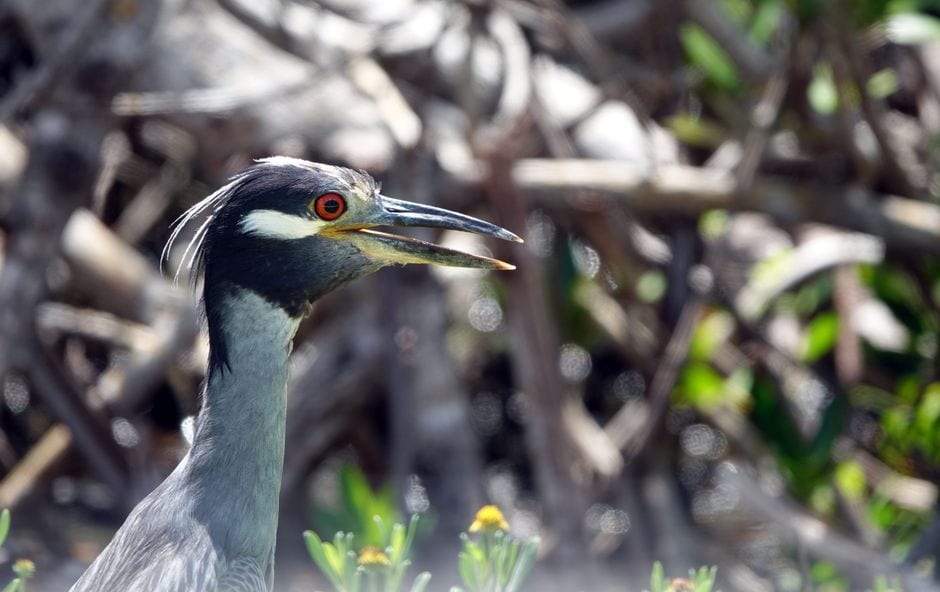
Yellow-crowned Night-Herons are night birds by name, but along Florida’s coast the tide can matter just as much as the hour.
These stocky herons specialize in crabs and other crustaceans and often patrol mangrove edges, tidal creeks, wet lawns, drainage areas and shallow coastal wetlands.
The head pattern is the fastest adult clue. Look for a blocky head, bold black-and-white face, thick dark bill and a pale yellow crown that can be subtle in poor light.
The body is smooth gray to purple-gray, and adults can show long pale head plumes during breeding season.
Young Yellow-crowned Night-Herons are brown and streaked, making them much harder to separate from young Black-crowned Night-Herons.
Food explains much of their schedule. Crabs and crayfish dominate the diet, and coastal birds often forage around the tidal cycle rather than simply waiting for darkness.
Cornell reports that coastal feeding is often concentrated from roughly three hours before high tide until three hours after high tide.
That makes the local tide table a useful birdwatching tool: a mangrove shoreline or tidal creek that seems empty at one point in the day may become productive as the water rises.
Yellow-crowned Night-Herons occur around coastal Southwest Florida and also use inland ponds, wooded streams and wet fields where crayfish are available.
The easy identification: blocky head, bold black-and-white face, thick dark bill and crab-hunting behavior point toward a Yellow-crowned Night-Heron. |
Want to know when to look? Check the tide.
Birdwatching meets the tide table.
Use NOAA’s live tide-prediction tool for your nearest station.
0 Comments
Join the conversation
Be the first to comment
Share your thoughts above.