
Six-Lined Racerunner: Florida's Native Ground Lizard Built for Speed |
If a striped lizard shoots across a sunny path like a tiny race car, don't assume it is exotic — this fast ground hunter is native to Florida and documented locally in Sarasota County preserves. |
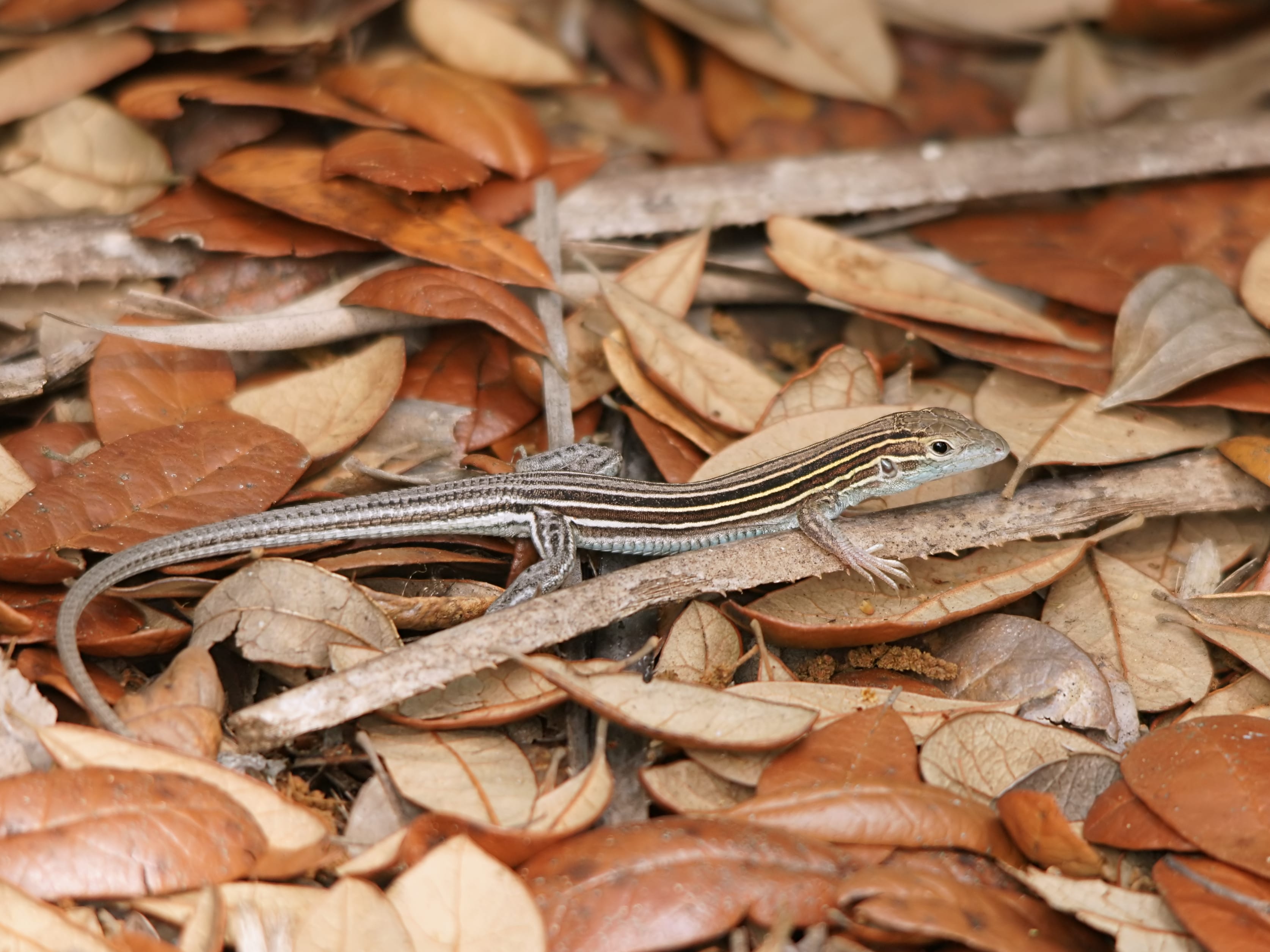
The six-lined racerunner is proof that not every unfamiliar Florida lizard is an introduced species.
This native ground lizard is long, slender and famously fast, often disappearing across a sandy trail or open patch of ground before a person gets a close look.
Six narrow light-colored stripes run lengthwise along a darker brown or black back and remain visible throughout life.
Adult males can develop blue coloration on the underside during the breeding season.
The long tail and streamlined body help separate racerunners from the chunkier anoles and skinks people commonly see around houses.
They are active hunters rather than sit-and-wait lizards, moving rapidly through open ground in search of insects and spiders.
Sunny, dry habitat is where this species makes the most sense.
Racerunners favor scrub, sandhills, dry flatwoods, dunes and other open places where warm ground and loose soil provide hunting and refuge.
They are documented in Sarasota County natural areas, including Old Miakka Preserve and the South Venice Lemon Bay Preserve system.
That makes them a genuine Wild Suncoast backyard-and-trail species, not just something found elsewhere in Florida.
Speed is their main defense.
When startled, they usually sprint for cover rather than stand their ground, so the best way to photograph one is to stop moving and let the lizard settle rather than chasing it.
They feed on insects and other small invertebrates and are part of the native food web for snakes, birds and other predators.
A striped lizard racing through a sunny sandy area should not automatically be labeled an invasive whiptail.
Florida does have nonnative whiptail relatives, which makes a clear photo of the stripes, head and body useful when identification is uncertain.
The Wild Suncoast clue: six permanent light stripes, a very long tail and astonishing ground speed point toward the native six-lined racerunner. |
Fast striped lizard on a sandy trail? It may be native.
Do not chase it for an identification.
Use the Florida lizard checklist and local preserve records to compare what you saw.
0 Comments
Join the conversation
Be the first to comment
Share your thoughts above.