
Red-Eared Slider: The Nonnative Pond Turtle With the Red Ear Patch |
That bright red stripe behind the eye is the giveaway. This former pet-store favorite is now established in Florida and can compete with native basking turtles. |
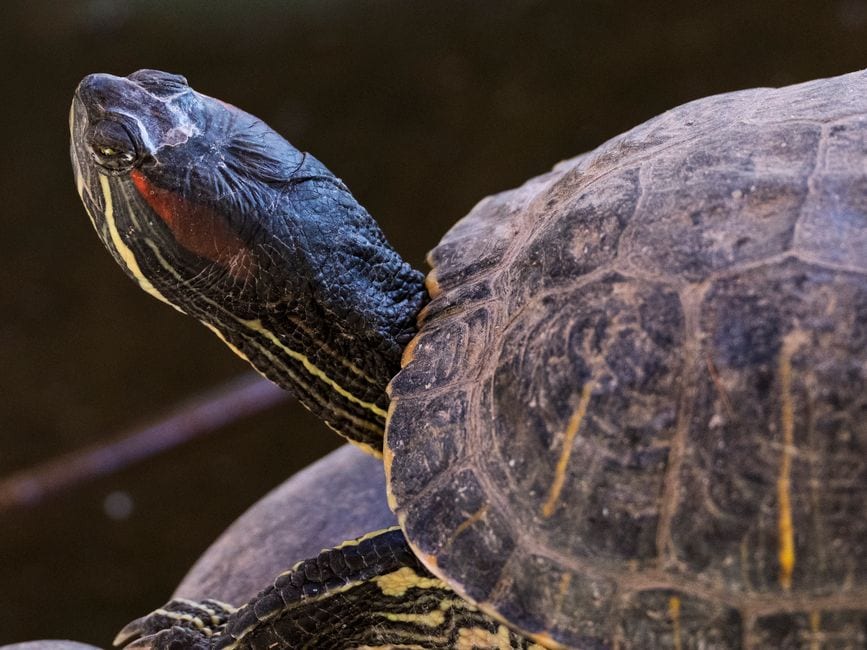
Red-eared sliders are easy to recognize when the signature field mark is visible: a red stripe or patch just behind each eye.
These freshwater turtles are native to parts of the central United States but not to Florida.
The pet trade helped spread them around the world, and released or escaped animals are now established in Florida ponds, canals and lakes.
They are strong competitors for the same resources native turtles need.
Red-eared sliders use basking sites, aquatic vegetation and other habitat also used by Florida’s native cooters and sliders.
Florida wildlife guidance also notes that red-eared sliders can interbreed with native yellow-bellied sliders.
The red ear patch is the quickest identification clue.
The head and neck otherwise carry yellow stripes, and the shell is usually greenish to dark brown with patterning that often fades as the turtle ages.
Older males can become very dark, making the red marking less obvious.
Do not confuse a nonnative turtle with permission to move or release it somewhere else.
Florida prohibits the release of nonnative animals into the wild.
Red-eared sliders are classified as a Conditional species in Florida. Under current FWC rules, a permit is required to acquire a red-eared slider for personal possession, with limited exceptions including certain animals already possessed before July 1, 2007 and distinctive albino or amelanistic color forms.
If you already have a nonnative pet turtle you can no longer keep, do not release it. FWC’s Exotic Pet Amnesty Program provides a legal rehoming route.
If you see a red-eared slider living in a public pond, do not start catching turtles on your own.
Photograph the animal, note where you saw it and use the state reporting system when the sighting is useful for tracking nonnative wildlife.
USGS’s Nonindigenous Aquatic Species database also tracks documented red-eared slider records and shows the species across multiple Florida drainages, including Southwest Florida watersheds.
Never solve a pet-turtle problem by releasing the turtle into a neighborhood pond.
The Wild Suncoast clue: a red patch behind the eye points strongly to the nonnative red-eared slider. |
Red-eared slider or native cooter?
Do not release or relocate pet turtles.
Compare the basking-turtle field marks first.
Watch a Close Relative: Yellow-Bellied Slider |

Why include this video? Yellow-bellied sliders and red-eared sliders are different subspecies of Trachemys scripta, so the video is useful for seeing the shared slider body shape, basking behavior and aquatic lifestyle.
Do not use the video alone to identify a red-eared slider in Florida. The red patch behind the eye remains the most useful quick field mark, and Florida-specific status and rules should be checked through FWC and USGS. |
0 Comments
Join the conversation
Be the first to comment
Share your thoughts above.