
Red-Bellied Woodpecker: The Florida Backyard Bird With the Misleading Name |
The belly patch is easy to miss. Look instead for the black-and-white barred back, gray face and red on the head of this common Florida woodpecker. |
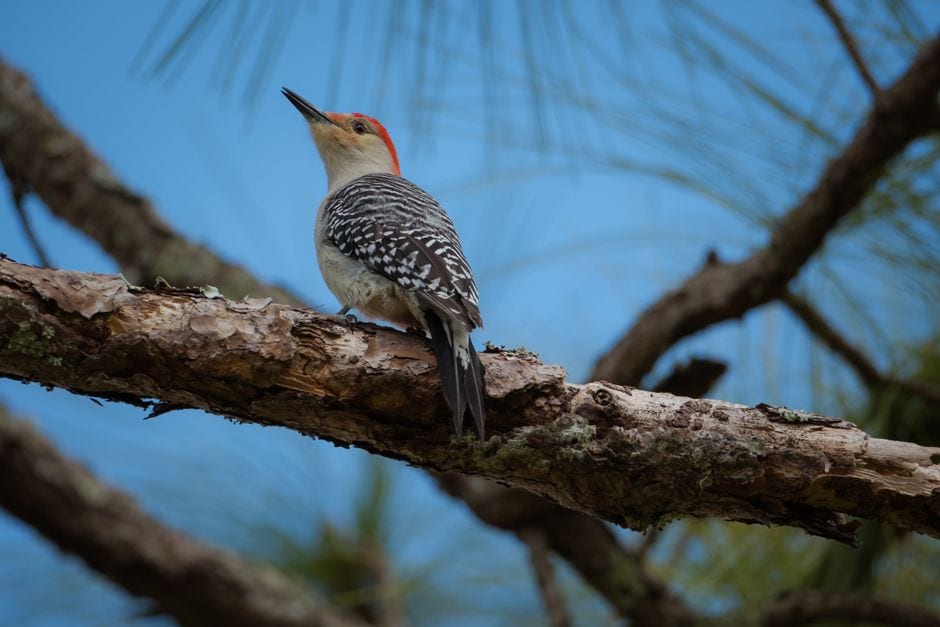
The Red-bellied Woodpecker is one of the most common woodpeckers in Florida, but its name points to the least useful field mark.
The small reddish patch on the belly is often hidden against a tree or difficult to see at all.
Look at the back and head instead. Red-bellied Woodpeckers have bold black-and-white barring across the back, a gray face and red on the head.
Adult males have red extending from the bill across the crown to the back of the neck.
Females have gray on the crown with red concentrated toward the back of the head and neck.
That also helps separate them from the less common Red-headed Woodpecker, which has a fully red head.
These birds are comfortable around people. They occur in pine flatwoods, oak hammocks, cypress areas and suburban neighborhoods, and they readily visit feeders for nuts, fruit and suet.
Their diet is broader than many people expect, including insects, fruits, nuts and occasionally small animals.
Like other woodpeckers, they need cavities for nesting and often use dead trees or snags when available.
Drumming on gutters, poles or other resonant surfaces is usually communication, not a bird trying to eat the metal.
Active woodpecker nests are protected under federal migratory-bird law and should not be disturbed.
The easy identification: barred black-and-white back, gray face and a red-capped head usually point to the Red-bellied Woodpecker — even when you cannot see a red belly at all. |
Is that the woodpecker in your yard?
Use the head and back, not the belly.
Open the Florida species guide for the fastest field marks.
0 Comments
Join the conversation
Be the first to comment
Share your thoughts above.