
Osprey or Bald Eagle? How to Tell Which Raptor You’re Seeing |
The quickest visual clues for two of Southwest Florida’s most familiar birds of prey |
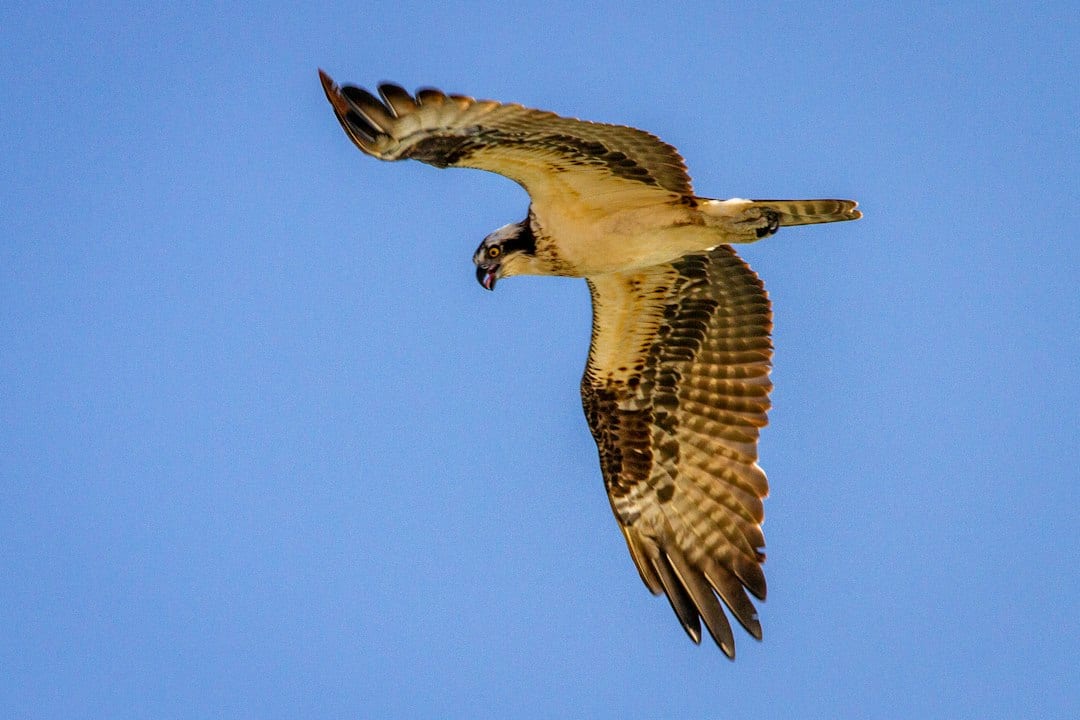
A large bird circling over a river, canal or bay can easily be mistaken for either an osprey or a bald eagle.
Both species are common around water, but their appearance and behavior are different enough that a few clues usually solve the mystery.
An adult bald eagle has a dark brown body, a bright white head and tail, and a large yellow bill.
Juvenile bald eagles are harder to identify because they are mostly brown with irregular white spotting and do not develop the familiar white head and tail until they are older.
Ospreys look lighter overall.
They have a white head and underside, a brown upper body and a bold dark stripe running through the eye.
That eye stripe is one of the easiest field marks when the bird is perched.
Behavior can be just as helpful as color.
Ospreys are fish specialists and are often seen hovering briefly before plunging feet-first toward the water.
Bald eagles also eat fish, but they are broader opportunists and may hunt, scavenge or even steal fish from ospreys.
In flight, ospreys often look narrower and more angular, while eagles look broader and heavier.
Size alone can be misleading at a distance, especially without another object for scale.
Southwest Florida offers excellent habitat for both birds because of its combination of open water, fish and tall nesting structures.
Bald eagles often nest in tall trees with a broad view of nearby water, while ospreys readily use poles, platforms and other elevated structures.
The practical takeaway: white head plus dark eye stripe usually points to an osprey; white head plus white tail and a massive yellow bill points to an adult bald eagle. |
Want to compare the field marks?
Want to compare the field marks?
Open FWC’s osprey guide for the key appearance and behavior clues.
0 Comments
Join the conversation
Be the first to comment
Share your thoughts above.