
Nile Monitor: Cape Coral's Giant Invasive Canal Lizard |
This semi-aquatic invasive lizard is established in Lee County, with Florida's largest known population in Cape Coral — where it threatens burrowing owls and other native wildlife. |
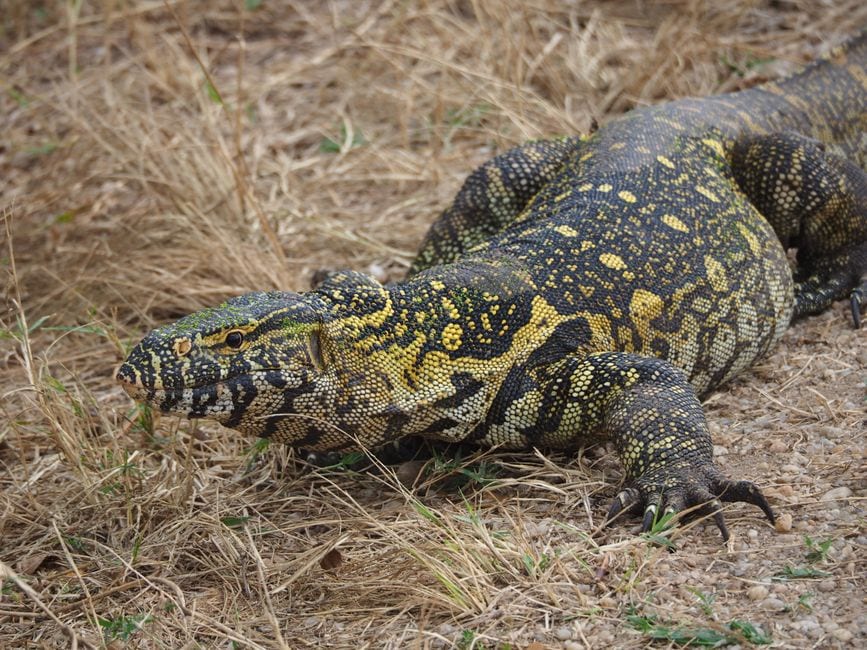
Cape Coral has one of Southwest Florida’s most unusual invasive-wildlife problems: a breeding population of giant Nile monitor lizards living around its canal system.
FWC lists Nile monitors as established in Lee County and says the largest known Florida population occurs in Cape Coral.
These are not iguanas.
Nile monitors are long, muscular, semi-aquatic lizards with narrow heads, no row of back spines and yellowish V-shaped markings and bands across a dark body.
The tail is extremely long and flattened enough to work like a rudder when the animal swims.
Typical adults can reach around five feet long, and very large individuals may exceed six feet.
Water is central to the Cape Coral story.
Nile monitors are excellent swimmers and frequently travel along canals, shorelines and other wet areas.
They also climb well and can hunt on the ground, underground, in trees and in water.
Almost anything small enough to catch can become prey.
Their diet can include crabs, fish, frogs, turtles, snakes, birds, eggs and small mammals.
That broad diet creates particular concern in Cape Coral because the city supports Florida’s largest population of burrowing owls as well as the largest known Nile-monitor population.
FWC also identifies potential threats to gopher tortoises, wading birds, sea turtles and other protected wildlife.
Do not try to capture a Nile monitor yourself.
FWC warns that they have strong jaws, sharp teeth and claws and will defend themselves when threatened.
If you see one, take a photograph from a safe distance, record the exact location and report it through Florida’s nonnative-species system.
Cape Coral also operates a local trapping program for Nile monitors.
The Wild Suncoast rule here is report, not chase.
The easiest comparison with an iguana: monitors are darker and more snake-like, lack the iguana’s row of back spines and carry yellow spots and bands rather than a tall crest. |
See a Nile monitor in Southwest Florida? Report it — don't chase it.
Keep your distance.
Nile monitors have powerful jaws and sharp claws and can defend themselves if cornered.
0 Comments
Join the conversation
Be the first to comment
Share your thoughts above.