
Greenhouse Frog: The Tiny Introduced Frog Hiding in Florida Flowerpots |
This fingertip-sized Caribbean frog travels easily in nursery plants and lays eggs on land — a good example of why 'introduced' does not always mean 'high-priority invasive.' |
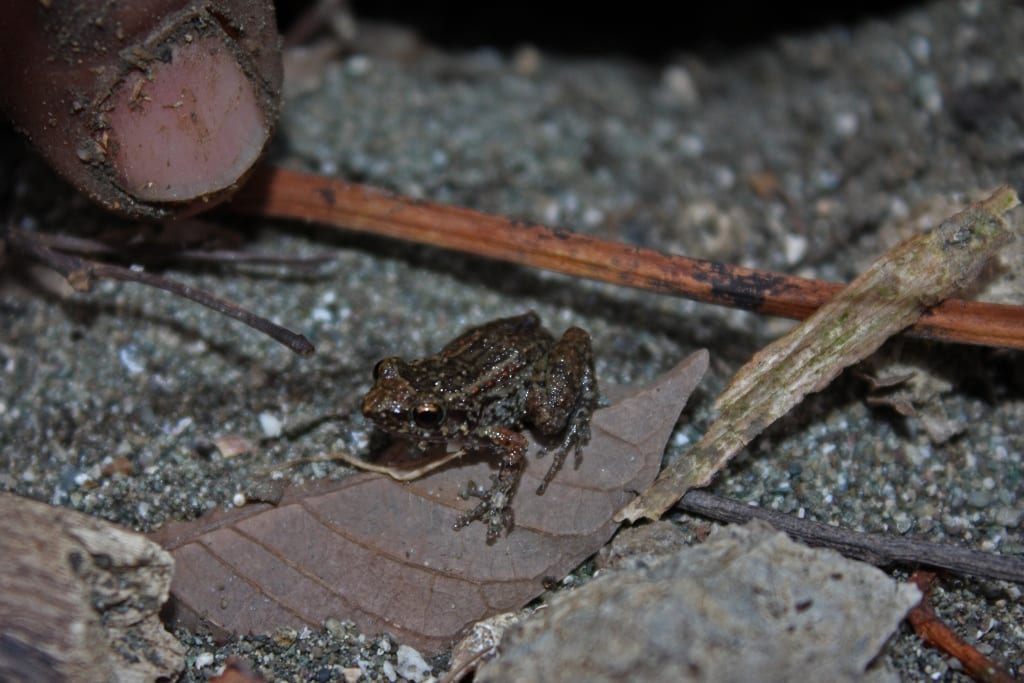
The greenhouse frog is one of Florida’s smallest introduced amphibians — and one of the easiest to move accidentally from one place to another.
Adults are tiny brown or tan frogs that spend much of their time hidden under leaves, mulch, boards, flowerpots and other damp cover.
Many people discover them while gardening or when one turns up in a swimming pool.
The nursery trade is part of their story.
Greenhouse frogs can hide in potted plants, and their eggs can travel with soil and landscaping material.
Unlike most Florida frogs, they do not need a pond for a tadpole stage.
The eggs develop directly into tiny froglets on land.
That direct-development strategy helps explain why the species spreads so easily with nursery plants.
Florida records of greenhouse frogs go back to the nineteenth century, and UF/IFAS treats the species as introduced in the state, although recent fossil and genetic research has raised interesting questions about its much older history in Florida.
This is an important vocabulary lesson for Wild Suncoast.
Greenhouse frogs are introduced and established, but they are not managed in the same way as high-priority invasive animals such as Burmese pythons, tegus, cane toads or green iguanas.
The ecological effects of greenhouse frogs are less clear, and UF/IFAS notes that much remains to be learned about their impacts.
They eat ants, beetles, roaches and other small invertebrates in leaf litter and gardens.
Finding one in a flowerpot is a reason to learn what it is, not a reason to panic.
The more important prevention step is avoiding the accidental movement of frogs and eggs in plants, soil and outdoor materials to places where the species is not already established.
The Wild Suncoast clue: tiny brown frog + damp flowerpot or leaf litter + no obvious pond nearby is a classic greenhouse-frog scenario. |
Tiny frog hiding in a flowerpot?
These frogs hatch as froglets, not tadpoles.
That is one reason eggs and frogs can travel unnoticed in nursery plants.
0 Comments
Join the conversation
Be the first to comment
Share your thoughts above.