
Green Iguana: Florida's Invasive Yard-Digger and Canal-Side Lizard |
These large invasive lizards damage seawalls, berms, canal banks and landscaping — and Florida removed more than 5,000 after the 2026 cold snap. |
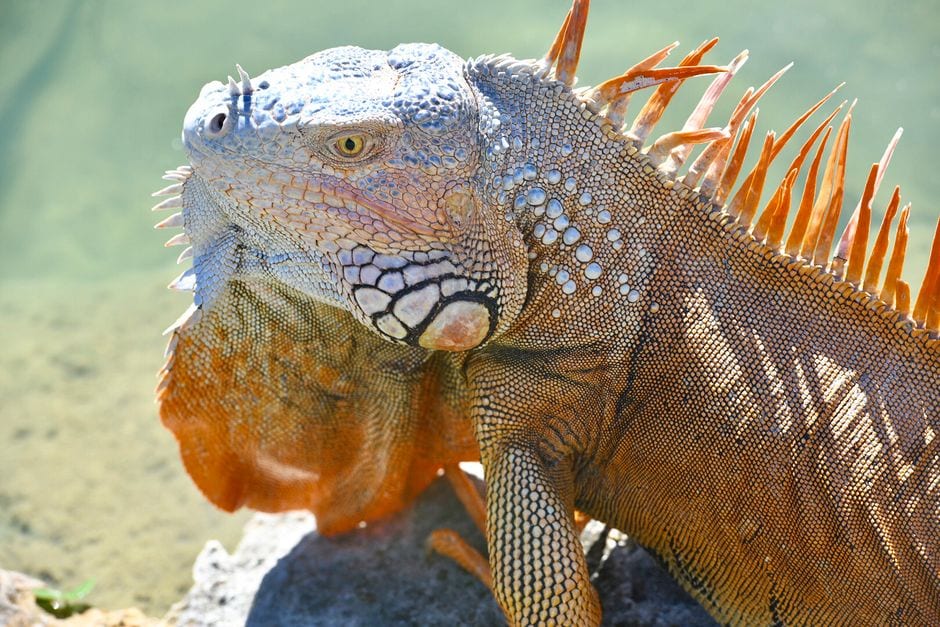
Green iguanas are one of Florida’s most visible invasive reptiles, especially along canals, seawalls, golf courses and landscaped neighborhoods.
Adults can grow more than five feet long from nose to tail and may be green, brown, nearly black or even orange-pink at certain times of year.
A row of spines along the neck, back and tail, a large throat fan and dark rings on the tail are strong identification clues.
The damage is often underground.
Green iguanas dig burrows that can weaken sidewalks, foundations, seawalls, berms and canal banks.
They also eat ornamental plants, flowers, garden vegetables and fruit.
Florida’s Gulf Coast populations are strongest farther south.
Wildlife officials list established populations in Lee and Collier counties, while reports farther north may represent escaped or released pets or isolated animals.
Green iguanas are tropical and do not tolerate prolonged cold well.
That vulnerability became unusually visible in 2026, when a cold event temporarily stunned large numbers of iguanas and Florida wildlife officials removed 5,195 animals under an emergency operation.
That emergency collection program has ended.
Residents should use current Florida guidance rather than assuming wildlife officers are still accepting live iguanas from the public under that cold-weather program.
Green iguanas are a prohibited nonnative species in Florida.
They may be humanely removed from private property with landowner permission, but captured animals cannot simply be relocated and released somewhere else.
For a questionable sighting north of the established range, a clear photograph and exact location are more useful than chasing the animal.
The Wild Suncoast clue: large size, dorsal spines, a hanging throat fan and a long ringed tail point strongly to a green iguana. |
See a suspected green iguana outside the established range?
Current FWC guidance matters.
The 2026 cold-weather live-iguana collection program has ended.
0 Comments
Join the conversation
Be the first to comment
Share your thoughts above.