
Florida Scrub-Jay or Blue Jay? The Easy Clues to Look For |
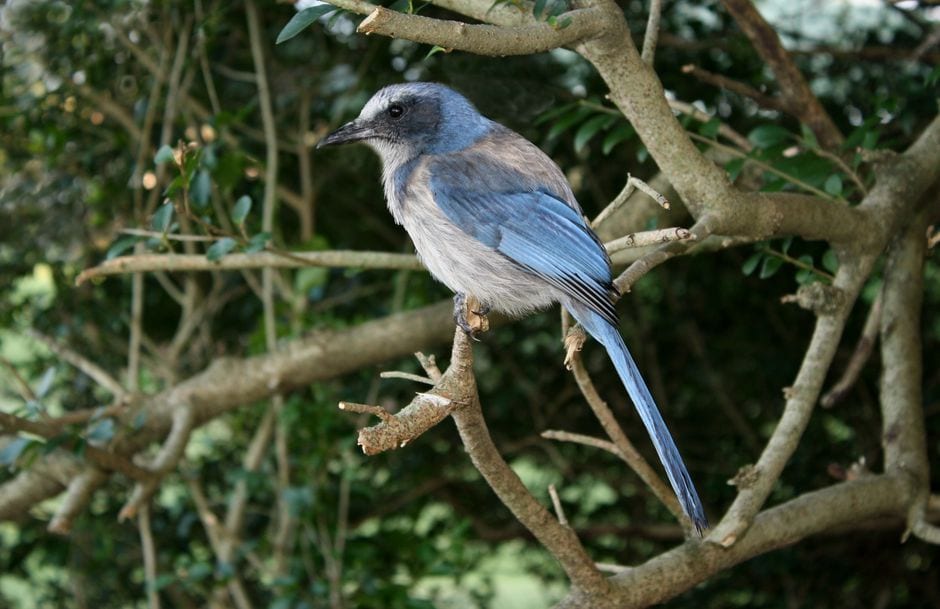
No crest and no bold black markings are the fastest clues that the blue bird in front of you may be Florida’s threatened scrub-jay. |
A blue bird that lands on a low oak, fence line or scrubby roadside can trigger an automatic “blue jay” guess — but in Florida, it is worth looking twice.
If the bird has no crest and no bold black necklace or barring, you may be looking at a Florida scrub-jay, a federally threatened native species tied to Florida’s disappearing scrub habitat.
The head is the fastest clue.
Florida scrub-jays have a smooth blue head with no crest. Their wings and tail are blue, while the back and underparts are gray to pale gray. The forehead and neck can look whitish.
Blue jays, by contrast, have a noticeable crest, strong black markings around the face and neck, and more dramatic black-and-white patterning on the wings and tail.
That makes the quick field test straightforward: crest or no crest; bold black markings or no bold black markings.
The setting can help too.
Florida scrub-jays depend on low, open scrub dominated by oaks and other shrubs. FWC notes that the species does best in habitat where the vegetation remains relatively low. When fire is suppressed and scrub grows too tall and dense, the habitat becomes less useful to the birds.
Scrub-jays are also unusually social.
They live in family groups. Young birds may remain with their parents and help defend territory or assist with later broods, a cooperative behavior that makes a group of birds moving together through scrub especially interesting to watch.
Their diet includes acorns, insects and small animals, and they often forage near the ground or along open edges.
Why does the identification matter?
The Florida scrub-jay is listed as threatened under the federal Endangered Species Act. Habitat loss, fragmentation and degradation remain major threats, particularly where Florida scrub has been converted to development or agriculture.
That means a correct identification is more than a birding exercise. It can help residents understand why certain pieces of scrub habitat matter and why development, fire management and habitat connectivity can become conservation issues.
If you think you have seen one, enjoy the bird from a respectful distance and use a zoom lens rather than moving closer. A clear photo showing the head, crest area, wings and tail is usually much more useful for identification than a distant blur.
The practical takeaway: a blue-and-gray jay with a smooth head, no crest and no bold black markings deserves a second look. In Florida, it may be one of the state’s most distinctive threatened birds. |
0 Comments
Join the conversation
Be the first to comment
Share your thoughts above.