
Cottonmouth or Watersnake? The Florida Snake ID That Causes Panic |
Most dark snakes near Florida water are not cottonmouths. Here are the safer clues — and what to do instead of getting closer. |
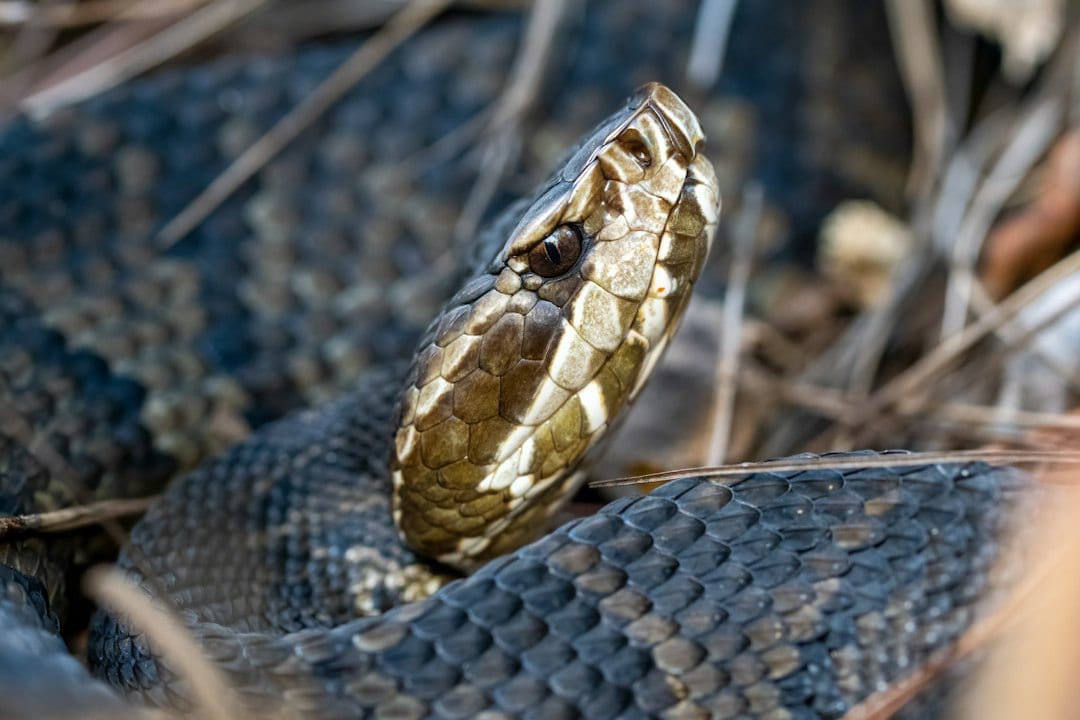
A dark snake beside a pond, canal or ditch can trigger an instant assumption in Florida: water moccasin.
But many snakes seen around water are harmless native watersnakes, and they are commonly mistaken for cottonmouths.
The Florida cottonmouth is venomous and should be observed only from a safe distance. Adults are heavy-bodied and may become very dark with age. Juveniles are lighter and often show reddish-brown crossbands plus a yellow tail tip.
Some identification clues can help when you already have a safe, zoomed photograph. Cottonmouths have a dark facial stripe, vertically elliptical pupils and a heat-sensing pit between the eye and nostril. When viewed from directly above, the eyes may be hidden by the brow ridge.
Florida’s nonvenomous watersnakes have round pupils, no facial pit and eyes that are generally visible from above.
Do not use head shape by itself. Harmless snakes can flatten their heads when frightened, making a nonvenomous snake look triangular.
Behavior is not a dependable shortcut either. A harmless watersnake may strike defensively when cornered, while a cottonmouth may simply remain still. FWC and the Florida Museum both emphasize distance rather than testing a snake’s behavior.
The safest response to an uncertain snake is the same either way: give it space.
If the snake is outdoors and has an escape route, keep children and pets away and let it move on. Do not try to pick it up, pin it with a tool or kill it because it is near water.
Many Florida watersnakes occupy the same ponds, marshes, canals and wetlands as cottonmouths, and harmless watersnakes are frequently killed because of mistaken identification.
If someone is bitten by a suspected venomous snake, seek emergency medical care immediately. Florida Poison Control advises against tourniquets, ice, cutting the bite or trying to suck out venom.
The practical takeaway: dark snake near water does not automatically mean cottonmouth. Use distance, zoom and reliable identification resources — not a close inspection. |
Snakebite? Get help now.
Snakebite? Get help now.
If someone may have been bitten by a venomous snake, seek emergency medical care immediately. Florida Poison Control is available 24/7 at 1-800-222-1222.

0 Comments
Join the conversation
Be the first to comment
Share your thoughts above.