
Cooper's Hawk: The Fast Backyard Bird Hunter You May Notice More This Fall |
Long-tailed, quick through trees and increasingly at home in suburbs, Cooper’s Hawks can become very noticeable around neighborhoods and bird feeders during migration and winter. |
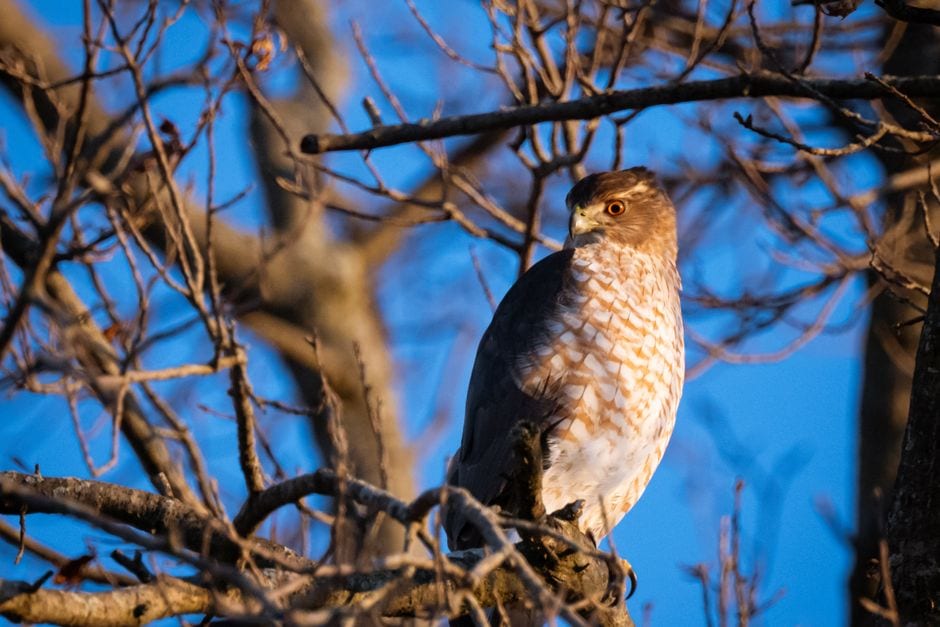
A sudden blur through the trees followed by an explosion of songbirds can be your first clue that a Cooper’s Hawk has arrived.
These woodland hawks are built for speed and maneuvering, with relatively short rounded wings and a long tail that acts almost like a rudder as they chase birds through branches.
Fall can make them more noticeable. Cooper’s Hawks are short- to medium-distance migrants, and birds from northern areas move south for winter while others remain year-round.
They are also increasingly comfortable in suburban neighborhoods, parks and streets lined with mature trees.
Adults show blue-gray backs, reddish barring across the chest, a dark cap and red eyes. Juveniles are browner, with streaked underparts and yellowish eyes.
Watch the flight style. A few quick wingbeats followed by a glide — often described as flap-flap-glide — combined with a long rounded tail is a strong clue.
Unlike Red-tailed Hawks, Cooper’s Hawks specialize heavily in birds, including doves, pigeons, jays, robins and other medium-sized species.
That is why they sometimes appear around bird feeders. The hawk is not interested in seed; it is interested in the birds gathering around it.
If one repeatedly hunts your feeder and you want to discourage the behavior, Cornell recommends taking feeders down for a few days so the concentration of prey disperses.
The fall takeaway: a long-tailed hawk moving fast through neighborhood trees may be a Cooper’s Hawk, especially as migration adds winter birds to the local population. |
Is a hawk hunting around your bird feeder?
Long tail + fast tree-level pursuit are strong clues.
Open the guide to compare what you saw.
0 Comments
Join the conversation
Be the first to comment
Share your thoughts above.