
Common Snapping Turtle: Florida's Native Freshwater Heavyweight |
The long tail, massive head and small lower shell identify this native turtle — and on land, the safest response is usually to give it room. |
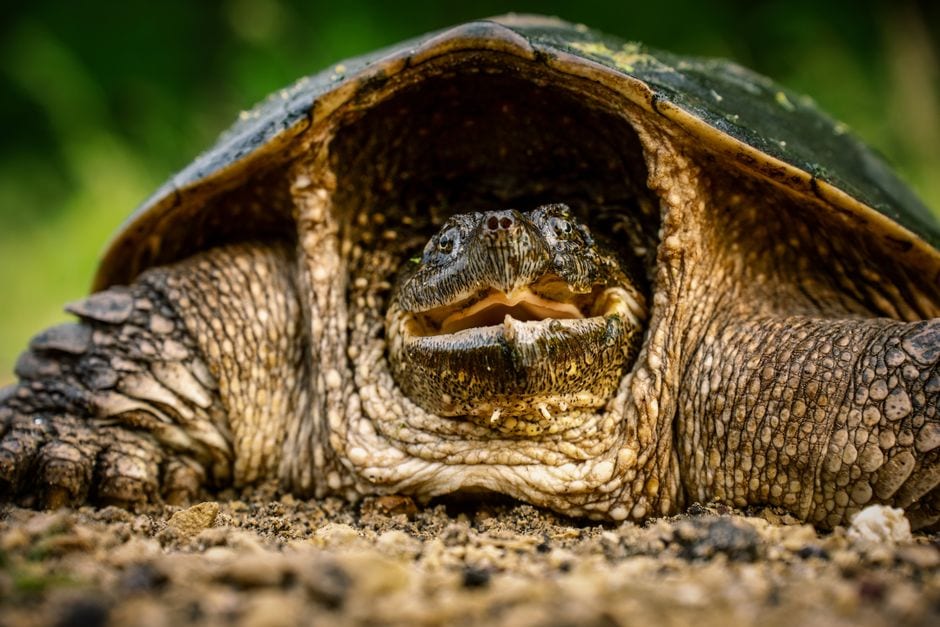
Common snapping turtles are native Florida freshwater turtles built very differently from the smooth-shelled basking turtles people see stacked on pond logs.
They have a large head, powerful jaws, a long saw-toothed tail and a relatively small lower shell that leaves much of the legs exposed.
The upper shell is usually dark brown to olive and may be coated with mud or algae, making an old animal look almost like part of the pond bottom.
In water, snapping turtles usually prefer retreat over confrontation.
On land, however, they have fewer escape options and can defend themselves quickly if approached or handled.
That is why a snapping turtle beside a road is not a turtle to pick up casually for a photograph.
Give it space, keep children and pets back and never lift a snapping turtle by the tail, which can injure the animal.
If a turtle is in immediate traffic danger and safe assistance is not obvious, contacting a wildlife professional is better than risking a serious bite.
Snapping turtles spend most of their lives in ponds, marshes, canals, lakes and slow-moving water, where they eat a broad mix of animal and plant material.
Females leave the water to nest, which explains why a large aquatic turtle can suddenly appear far from a pond.
Florida currently prohibits taking common snapping turtles from the wild.
The rule protects them partly because they can be confused with Florida’s imperiled alligator snapping turtles.
Alligator snapping turtles have a much more limited natural Florida range centered in northern and northwestern river systems, while common snapping turtles are the more broadly distributed species.
The important Southwest Florida lesson is not to turn every large, rough-looking turtle into an alligator snapper story.
A clear photograph from a safe distance can usually resolve the identification without touching the animal.
Florida also asks residents to report sick or dead freshwater turtles because turtle fraservirus has been detected in snapping turtles and other species.
The Wild Suncoast clue: massive head, long ridged tail and a small lower shell point toward the native common snapping turtle. |
Snapping turtle on land? Give it space.
Florida protects common snapping turtles from take.
Use current FWC freshwater-turtle guidance before trying to intervene.
0 Comments
Join the conversation
Be the first to comment
Share your thoughts above.