
Brown Anole: The Nonnative Lizard That's Everywhere in Florida Yards |
Brown anoles are introduced, not native — but they are so widespread that many Floridians assume they belong here. The orange-and-yellow dewlap is one of the best clues. |
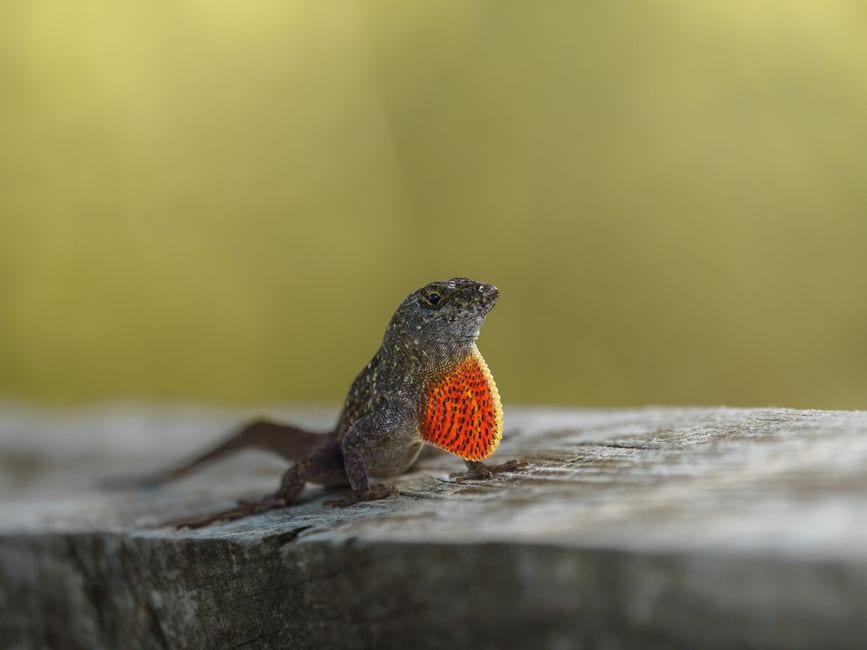
The little brown lizards racing across patios and sidewalks are so common that many Floridians assume they are native.
They are not.
The brown anole was introduced from Cuba, the Bahamas and other Caribbean islands and has spread through nearly all of peninsular Florida.
It was also the first introduced reptile documented in Florida.
Today brown anoles thrive especially well around yards, shopping centers, golf courses, parking-lot landscaping and other human-modified places.
They usually stay close to the ground or low on trunks, fences and walls.
The male's dewlap is one of the best identification clues.
When displaying, a male can extend a bright orange to red-orange throat fan edged in yellow.
Brown anoles also tend to have heavier patterning than native green anoles and a shorter, blunter-looking head.
One important rule: brown anoles never turn green.
The native green anole can turn brown or gray, so body color by itself is not enough to separate the two species.
Research has shown that where brown anoles become abundant, native green anoles often shift higher into shrubs and trees rather than using the same low perches.
Brown anoles eat insects and other small animals, including sometimes smaller lizards.
Nonnative does not automatically mean every individual is a high-priority removal target.
For Wild Suncoast readers, this species is useful because it teaches the difference between a common introduced animal and the more aggressively managed invasive species such as tegus, Burmese pythons or green iguanas.
The easiest clue is the combination of low-perching behavior, heavy brown patterning and that orange-and-yellow dewlap. |
Brown anole or native green anole?
Color alone is not enough.
Use the UF/IFAS guide to compare the two common yard lizards.
0 Comments
Join the conversation
Be the first to comment
Share your thoughts above.