
Black Spiny-Tailed Iguana: Gasparilla Island's Invasive Reptile Story |
A population that began with just a few released pets spread across Gasparilla Island — where the iguanas now burrow, damage property and interact with protected gopher tortoises. |
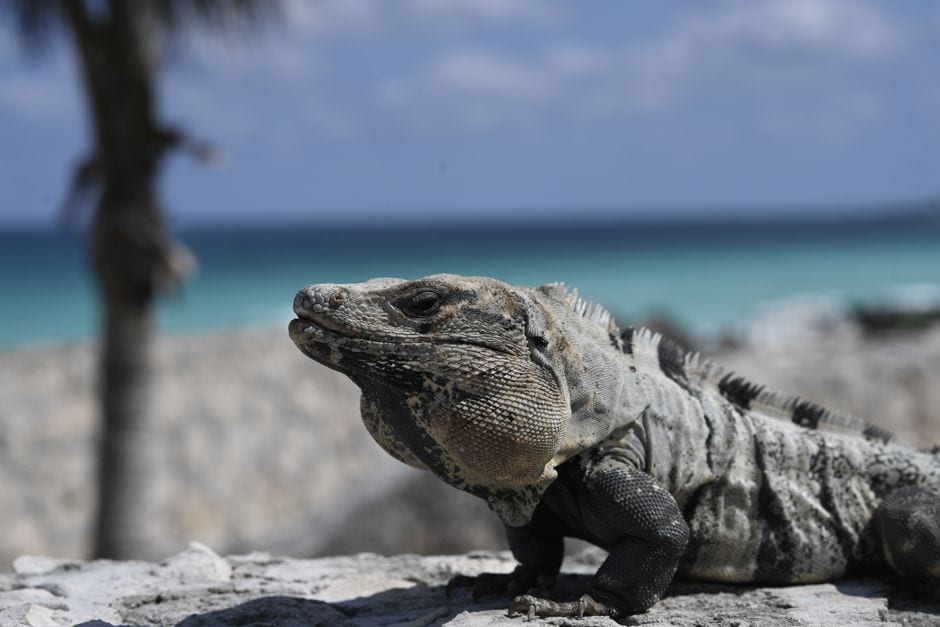
Gasparilla Island has one of Southwest Florida’s most remarkable invasive-reptile histories.
According to UF/IFAS, the island’s black spiny-tailed iguana population traces back to only a few animals brought from Mexico as pets in the late 1970s or early 1980s and later released near the southern end of the island.
By the early 2000s, the population had spread across Gasparilla Island and beyond.
Adults can grow more than four feet long, including the tail.
They are usually gray or tan with dark bands across the body and a long tail ringed with prominent spiny scales.
Breeding males may develop orange on the head, which sometimes causes confusion with other Florida nonnative lizards.
On Gasparilla Island, however, they are the only established large nonnative lizard, which makes identification much easier.
The iguanas dig extensive burrows under foundations, walls, sidewalks, seawalls and other structures and can damage landscaping by feeding on flowers, leaves, vegetables and fruit.
The wildlife story is even more important.
Black spiny-tailed iguanas use gopher tortoise burrows and have been documented preying on juvenile gopher tortoises on the island.
They may also threaten ground-nesting birds and sea-turtle hatchlings, although the size of those impacts is still being studied.
Gasparilla Island has had organized iguana-removal programs for years, and UF/IFAS reports that ongoing removal has reduced numbers even though full eradication is considered unlikely.
Residents should not interfere with authorized traps.
Managers already know the species is established on and around Gasparilla Island, so ordinary sightings there do not need to be repeatedly reported through the statewide invasive-species system.
UF/IFAS does recommend that visitors who see iguanas inside Gasparilla Island State Park report them to park staff, where management protects native plants and animals.
Do not feed the iguanas, handle them or release pet reptiles into the wild.
If cornered or grabbed, a black spiny-tailed iguana can defend itself with teeth, claws and its spiny tail.
The Wild Suncoast clue: a big gray-tan lizard with dark body bands and a heavily spined tail on Gasparilla Island is part of a very local invasive-wildlife story. |
On Gasparilla Island, use the local iguana guidance — not a generic invasive-lizard response.
This is a highly local management story.
UF/IFAS has a detailed Gasparilla Island guide covering history, identification, impacts and what residents can do.
0 Comments
Join the conversation
Be the first to comment
Share your thoughts above.