
Belted Kingfishers Are Showing Up for Winter: What to Watch Along Florida Waterways |
Listen for the rattling call first: northern Belted Kingfishers move south for winter and can be easier to notice along canals, ponds, estuaries and shorelines. |
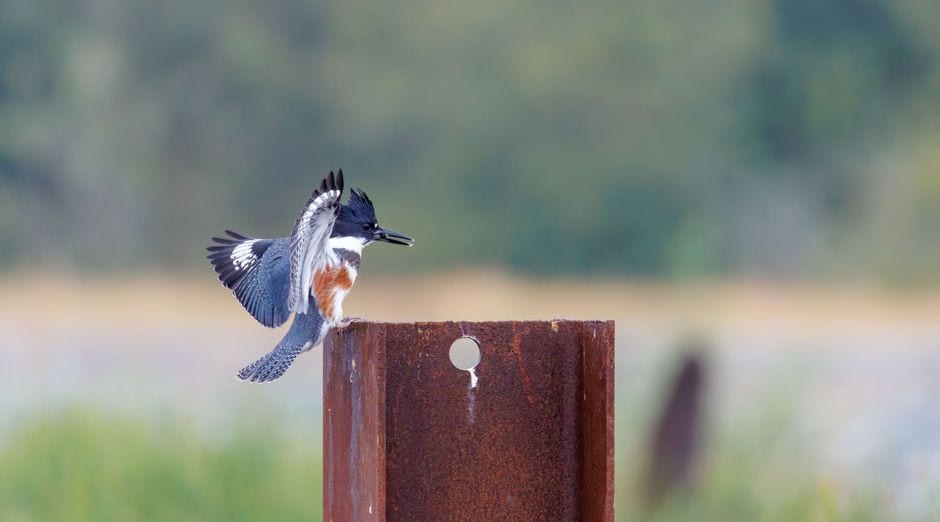
A loud, dry rattle over a canal or pond is often the first clue that a Belted Kingfisher is nearby.
These blue-gray fishing birds live around open water and perch on branches, wires, pilings and other lookout points before diving after fish.
Fall matters because some Belted Kingfishers migrate. Birds breeding as far north as Canada and Alaska move south for winter, while others remain year-round where open water stays available.
That seasonal movement can make kingfishers more noticeable along Southwest Florida canals, ponds, estuaries, mangrove edges and shorelines.
Look for a large head, shaggy crest, heavy straight bill and blue-gray upperparts over a white belly.
The female is actually more colorful than the male. Both have a blue breast band, but females also show a rusty chestnut band across the belly.
Kingfishers often patrol a stretch of shoreline, then hover briefly or plunge from a perch to catch small fish and crayfish.
They nest very differently from most familiar backyard birds, digging horizontal tunnels into soft earthen banks.
The best way to find one is often to listen before you look. That sharp rattling call can carry well across open water.
The seasonal takeaway: if a noisy blue-gray bird suddenly appears along your canal or neighborhood pond this fall, it may be one of the northern kingfishers arriving for the winter season. |
0 Comments
Join the conversation
Be the first to comment
Share your thoughts above.