
Audubon's Crested Caracara: Florida's Threatened Prairie Raptor With the Orange Face |
This distinctive south-central Florida raptor is federally threatened — and eggs have been documented from September through April, putting fall inside its breeding window. |
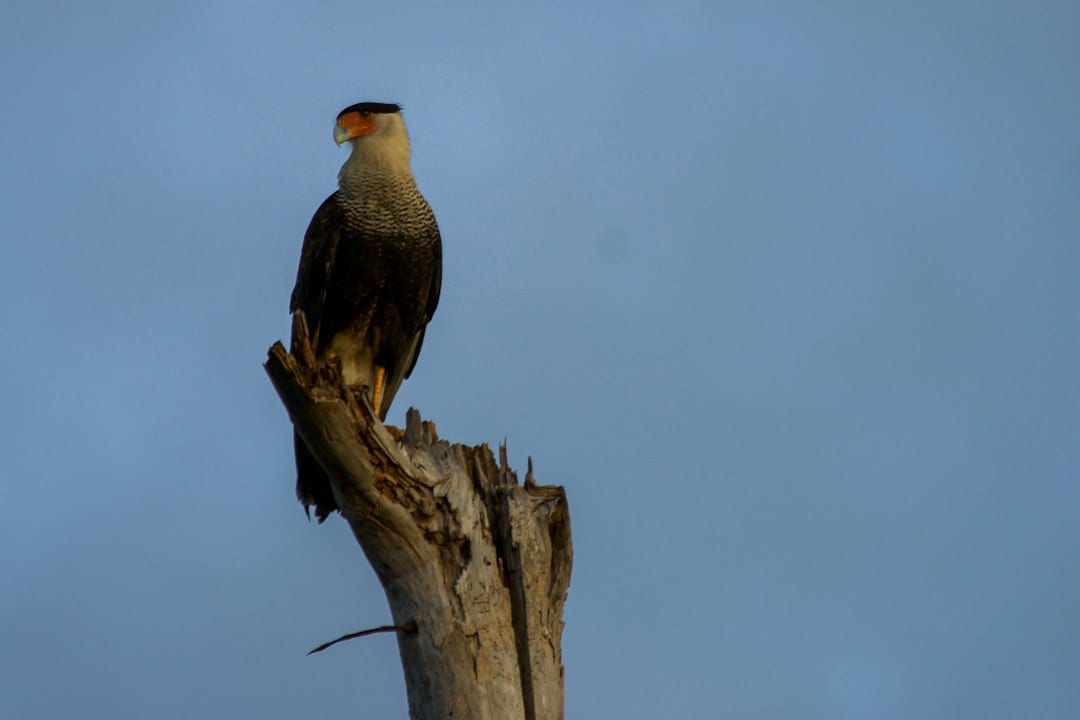
Audubon’s Crested Caracara looks part hawk, part falcon and part vulture — and in Florida it carries federal threatened status.
Adults are bold birds with a dark body, white neck and head, black crest, heavy gray-blue bill, orange-red facial skin and long yellow legs.
Unlike many raptors, caracaras spend a lot of time on the ground. They walk through pastures and prairies hunting small animals, eating carrion and investigating food that other birds might overlook.
Florida’s population is concentrated in south-central prairie and ranch country, especially landscapes with open grassland, scattered cabbage palms, saw palmetto and wetlands.
That habitat preference makes large open ranches and prairie country much more promising than dense suburban neighborhoods.
Fall is already part of the breeding window. FWC reports caracara eggs in Florida from September through April, with breeding activity peaking from January through March.
Nests are typically placed in cabbage palms or other trees and built from sticks, weeds and vines.
The Florida population was listed as threatened under the federal Endangered Species Act in 1987. Habitat loss, road mortality and disturbance around nesting areas remain important concerns.
If you see a caracara, enjoy it from a distance. Do not approach a nest or repeatedly disturb a perched pair for photographs.
The easy identification: long yellow legs, a white neck, black crest and orange-red face on a large ground-walking raptor strongly point to an Audubon’s Crested Caracara. |
See a caracara in Florida ranch country?
Orange face + white neck + long yellow legs are strong clues.
Open the official Florida species profile.
0 Comments
Join the conversation
Be the first to comment
Share your thoughts above.