
Argentine Black-and-White Tegu: Charlotte County's Invasive Giant Lizard |
This large South American lizard now has a reproducing population in Charlotte County — making local sightings worth photographing and reporting. |
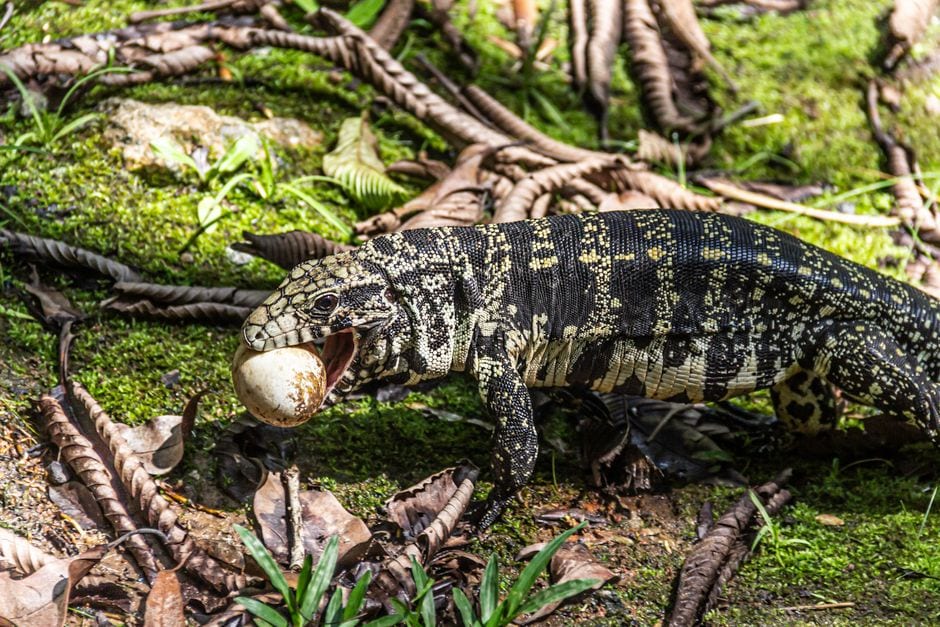
Argentine black-and-white tegus are no longer just a faraway South Florida problem.
Florida wildlife managers now list a reproducing population in Charlotte County, putting this invasive giant lizard squarely inside the Wild Suncoast coverage area.
Adults can approach five feet long, with a heavy body, powerful tail and a mottled black-and-white pattern that often forms bands across the back and tail.
Young tegus can be especially striking because hatchlings may have bright green heads before that color fades.
These are ground-dwelling lizards.
They use roadsides, fence lines, disturbed areas and burrows and can swim well even though they usually stay close to the ground.
The concern is what they eat.
Tegus are omnivores that consume fruit, insects, small animals and eggs, making them a threat to ground-nesting wildlife.
Florida research has documented tegus eating alligator eggs and juvenile gopher tortoises, and they can potentially raid nests of other reptiles and ground-nesting birds.
They are also capable of surviving cooler conditions than green iguanas.
During winter they retreat into burrows for a brumation period, then typically begin emerging again as temperatures warm.
A Charlotte County sighting matters.
If you see a suspected tegu, do not chase or handle it just to prove the identification.
Take a clear photograph if it can be done safely, record the location and date, and report the animal through Florida’s nonnative-species reporting system.
The state specifically asks the public to call its invasive-species hotline for high-priority species including tegus.
This is one Wild Suncoast species where a local reader report can genuinely help wildlife managers track an active invasion front. |
Think you saw a tegu in Charlotte County? Report it.
Tegus are a high-priority report species.
A good photo and exact location help confirm and track the population.
0 Comments
Join the conversation
Be the first to comment
Share your thoughts above.