
American Kestrel: Florida's Smallest Falcon Has Two Different Seasonal Stories |
By October, Florida can hold both year-round Southeastern American Kestrels and northern migrants arriving for winter — birds that look so similar the calendar becomes an important clue. |
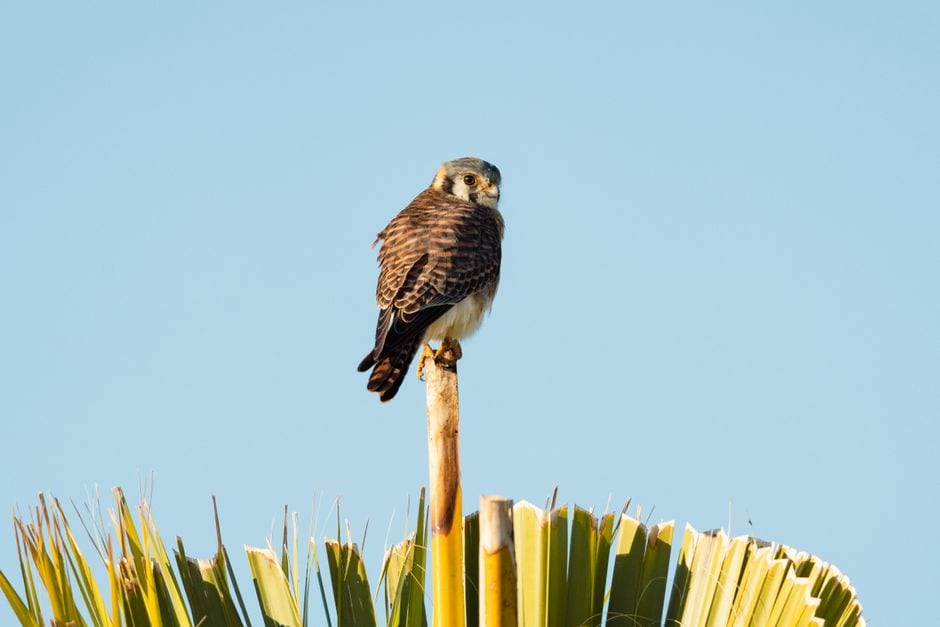
American Kestrels give Florida birdwatchers an unusual identification problem: the state has both a threatened resident subspecies and northern birds that arrive for winter.
The Southeastern American Kestrel lives in Florida year-round and is listed by the state as Threatened. The northern American Kestrel subspecies is migratory, typically arriving in Florida by September and leaving by early April.
That means October is overlap season. A kestrel on a wire or utility pole in Southwest Florida could be a resident Southeastern bird or a northern winter visitor.
FWC says the two forms are so similar that separating them by appearance alone is nearly impossible in the field. Time of year is one of the most reliable clues: a kestrel seen in Florida from May through July is almost certainly the resident Southeastern subspecies because northern migrants are gone.
American Kestrels are tiny falcons, roughly dove-sized, with pointed wings and two dark vertical marks on the face. Males show blue-gray wings with a rusty back; females are more uniformly reddish-brown and barred.
They hunt from wires, poles and exposed branches over open country, dropping onto grasshoppers, lizards, mice and other small prey. They may also hover in place while facing into the wind.
Southwest Florida is part of the resident kestrel story. FWC’s resident range includes Charlotte, Sarasota, Lee, DeSoto and other Florida counties where suitable open habitat remains.
Loss of nesting cavities and open fire-maintained habitat is the major threat to the Southeastern American Kestrel. Nest boxes and preservation of suitable dead-tree cavities can help.
The October takeaway: kestrels become easier to encounter as northern migrants arrive, but an October bird cannot be confidently labeled resident or migrant from plumage alone. |
Resident kestrel or winter visitor?
May through July is the clearest clue.
A Florida kestrel then is almost certainly the resident Southeastern subspecies.
0 Comments
Join the conversation
Be the first to comment
Share your thoughts above.