
Barking Treefrog: Florida's Big Native Treefrog With the Dog-Like Call |
After a summer rain, a chorus of hollow "tonk" calls from a wet pine flatwoods may be this frog, not a distant dog. |
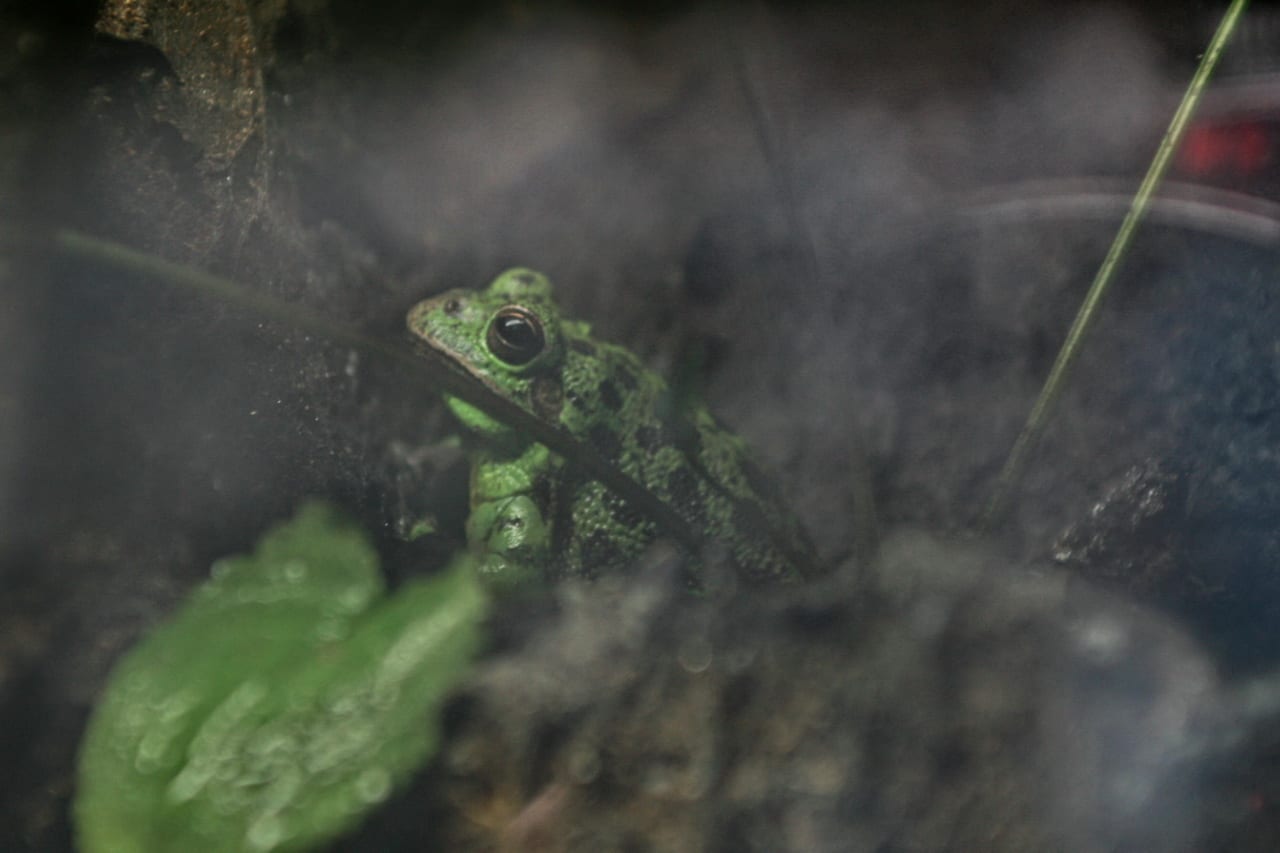 Barking treefrog. Photo: Cliff from Arlington, Virginia, via Wikimedia Commons, CC BY 2.0 |

Listen to a chorus of barking treefrogs in this recording from the Florida Museum of Natural History at the University of Florida: play the barking treefrog chorus. More Florida frog calls are on the Florida Museum frog calls page. |
The barking treefrog is the largest native treefrog in Florida, and its call is the reason for the name.
The Florida Museum of Natural History lists it as a plump, bumpy frog, usually 2 to 2.5 inches long. Its color changes between brown, green and gray, and many carry round dark spots on the back. UF wildlife researchers describe the breeding call as a hollow "tonk, tonk." A full chorus, they say, sounds like distant barking dogs.
Where it lives Barking treefrogs are found across most of Florida, except the Everglades and the Keys. They favor sandy pinelands and swampy woods near standing water, and they spend much of their time up in vegetation. In the coldest weather they burrow into sandy soil or shelter in gopher tortoise and mouse burrows, according to the Florida Museum.
When to listen UF/IFAS gives the breeding season as March to August. The frogs breed in shallow, fish-free wetlands such as cypress domes, flooded ditches and wet hammocks, so the loudest nights usually follow heavy rain. They eat beetles and other small invertebrates. The video and audio link above let you hear the call.
A frog that puffs up When threatened, the frog inflates its body to look larger and harder for a snake to swallow. Individuals have been known to live more than 10 years.
Native versus invader Do not confuse it with the Cuban treefrog, a nonnative species that UF/IFAS says has hurt native frog populations. The Cuban treefrog can reach about 5 inches, roughly double the barking treefrog's size.
Sources: Florida Museum of Natural History; UF Wildlife Ecology and Conservation; UF/IFAS Gardening Solutions. |
0 Comments
Join the conversation
Be the first to comment
Share your thoughts above.