
Tropical House Gecko: The Nonnative Night Lizard Around Florida Porch Lights |
The chirping lizard on your wall after dark came from Africa, and it has been spreading across Florida for decades. |
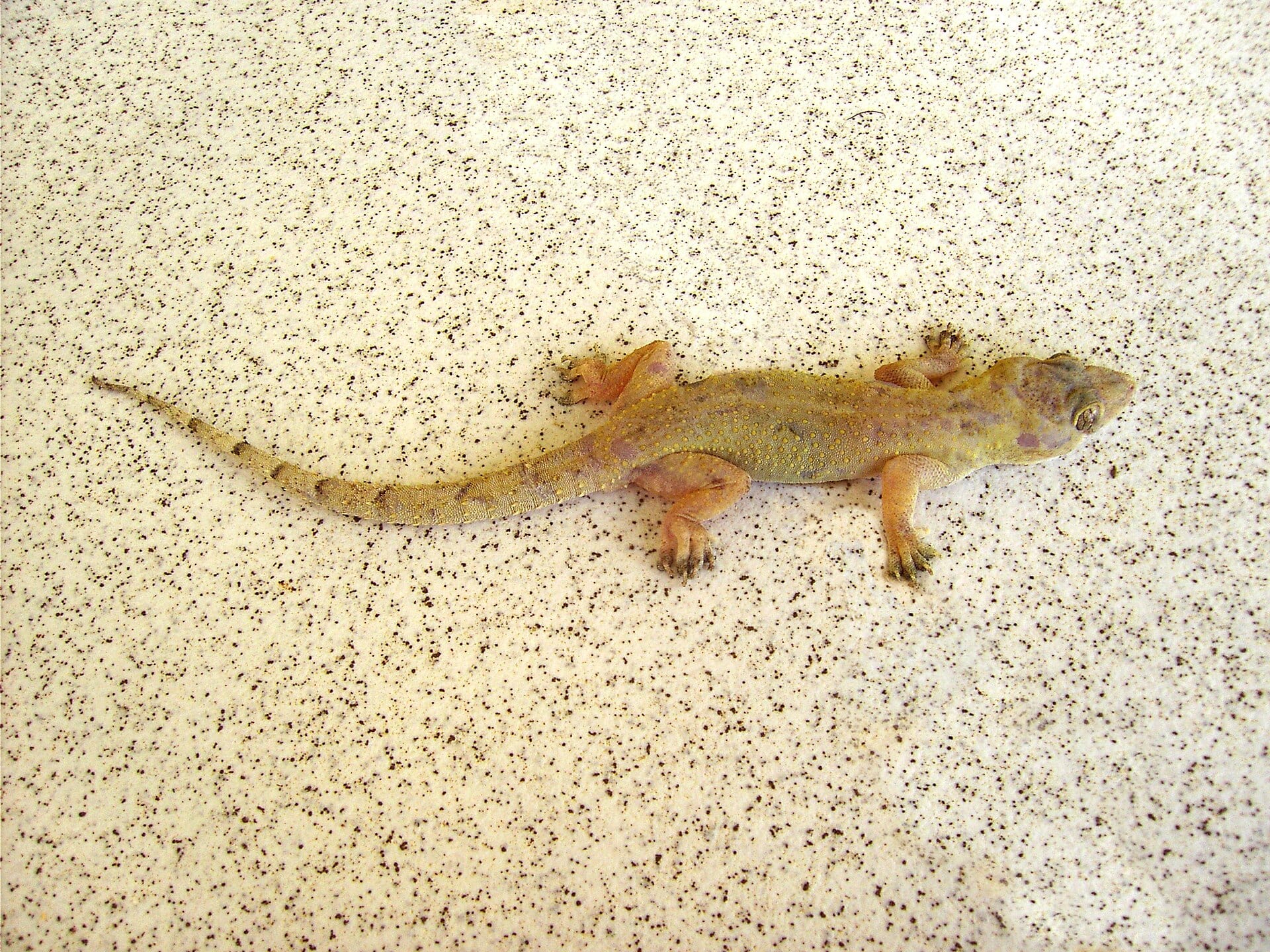 Tropical house gecko. Photo: Hans Hillewaert, via Wikimedia Commons, CC BY-SA 4.0 |
The small gecko clinging beside your porch light is probably not from Florida at all.
Florida has just one native gecko, the Florida reef gecko, according to UF herpetologists. The state is home to roughly ten established nonnative species, which arrived in cargo or through the pet trade. UF/IFAS Sarasota County notes that house geckos are the nonnative geckos most commonly seen in Sarasota.
Meet the tropical house gecko The tropical house gecko is native to Africa. It grows up to about 5 inches long, in shades of tan, gray or olive-brown, with large eyes and wide, spread toes. It is active at night and waits near lights for moths and cockroaches. UF/IFAS Extension says that when alarmed, geckos can make a squeak or high-pitched call. The video above has a house gecko chirping.
A fast spreader A study of 398 locations in central and southern Florida found the tropical house gecko increasing by more than 10 percent per year. At several sites it completely displaced another introduced species, the Indo-Pacific gecko, in under seven years.
Does it matter to wildlife? Researchers say it may eat small native lizards, but UF/IFAS Extension says little is known about its effect on native frogs and lizards. Cuban treefrogs, also nonnative, have been photographed eating these geckos near building lights.
What to do Geckos eat insects, so fewer bugs around the house means fewer geckos. UF/IFAS advises against glue boards because geckos caught on them cannot be released.
Sources: UF/IFAS Extension; UF Wildlife Ecology and Conservation (Krysko et al. gecko key); University of Florida research in Biological Invasions; UF/IFAS Sarasota County. |
0 Comments
Join the conversation
Be the first to comment
Share your thoughts above.