
Knight Anole: The Giant Green Nonnative Lizard Recorded in Sarasota County |
It looks like a small iguana, but this Cuban import is the largest anole in the world. |
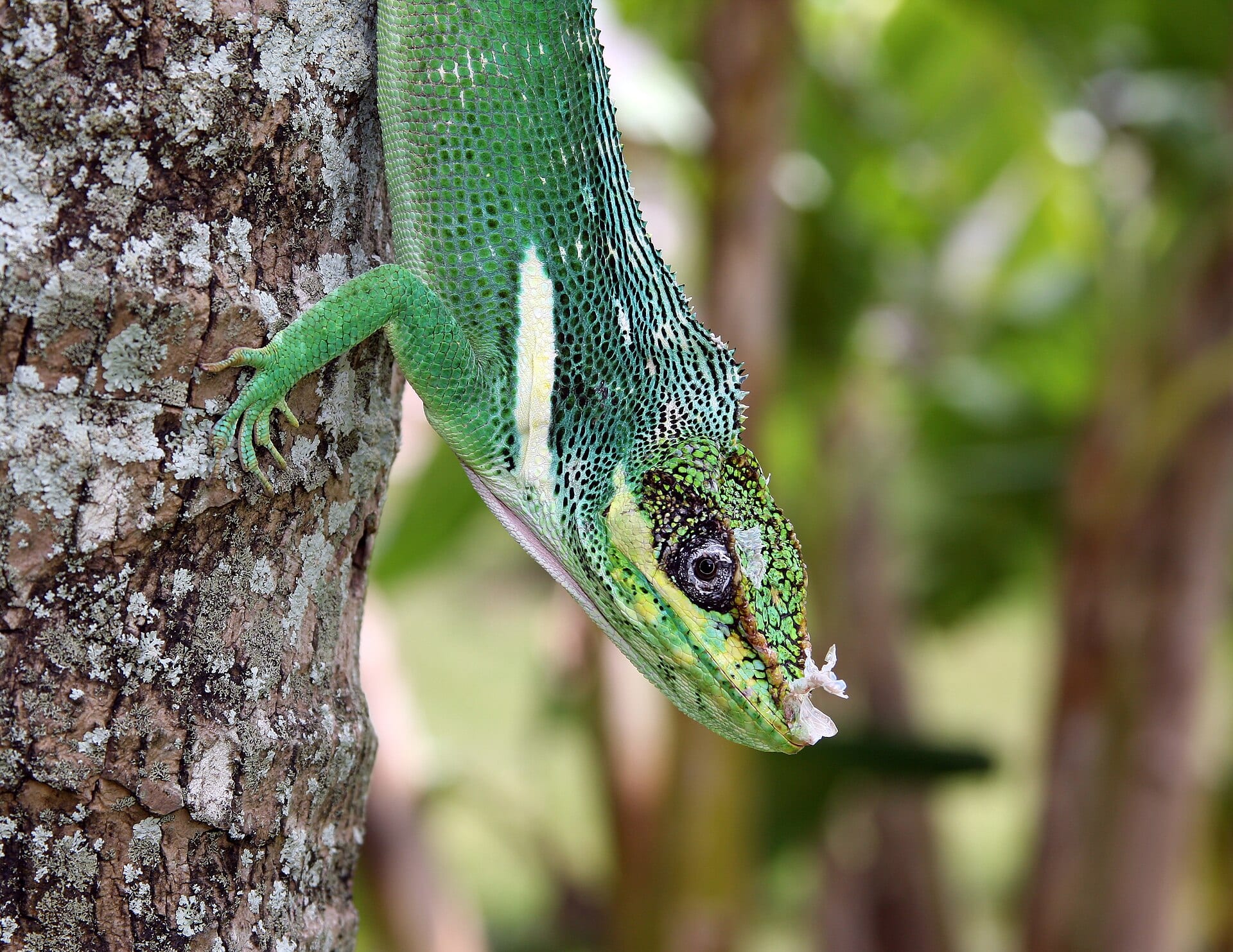 Knight anole. Photo: Ianaré Sévi, via Wikimedia Commons, CC BY-SA 3.0 |
If you spot a bright green lizard much bigger than a green anole, you may be looking at a knight anole.
The knight anole is the largest species of anole, and it is a nonnative species in Florida. UF/IFAS Sarasota County says knight anoles have been recorded in the county, though they are less common than brown anoles. They stand out from native green anoles by their larger size, big head, yellow markings and rougher skin.
How it got here Florida Museum researchers report the species was first introduced in Miami-Dade County in 1952, at the University of Miami campus in Coral Gables. Florida Fish and Wildlife says it has since been recorded in 11 counties. Adults commonly reach well over a foot long.
What it eats Young knight anoles eat mostly insects. Adults take larger prey, including other lizards, frogs, fruit and sometimes nesting birds. Researchers have also documented them eating a native corn snake and invasive Cuban treefrogs. That makes them a concern for native green anoles.
Behavior Knight anoles are active by day, live high in trees, and are territorial. They tend to face a threat and hold their ground rather than flee, and they can bite. A bright throat fan, called a dewlap, and head bobbing are part of how they signal. Knight anoles do not call out loud, so the video above shows the display instead.
Sources: UF/IFAS Sarasota County; Florida Museum of Natural History (Camposano and Krysko, Iguana, 2008); Florida Fish and Wildlife Conservation Commission; Journal of Reptiles and Amphibians. |
0 Comments
Join the conversation
Be the first to comment
Share your thoughts above.